The Museum of Modern Art New York Painting and Sculpture Acquisitions 1962
The 100 best paintings in New York: Museum of Mod Art
Discover which of the 100 best paintings in New York can be found at the Museum of Modern Fine art
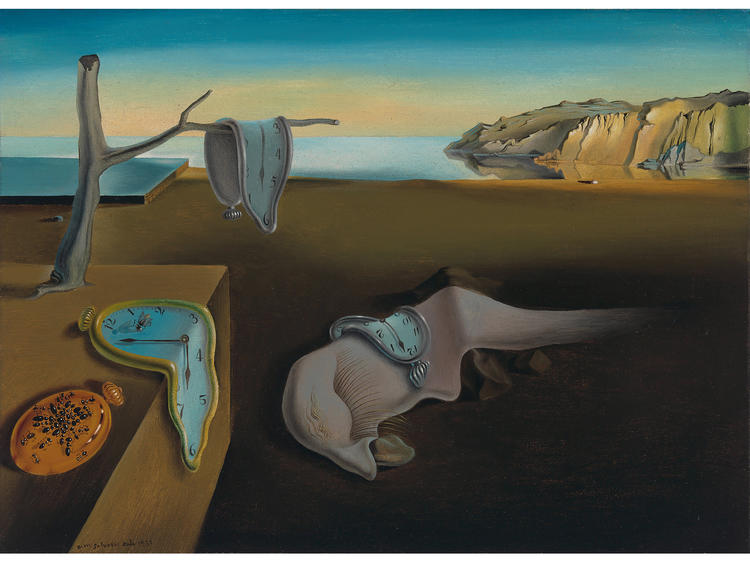
The Persistence of Memory (1931), Salvador Dalí
Rank: 100
Dalí described his meticulously rendered works as "hand-painted dream photographs," and certainly, the melted watches that make their appearance in this Surrealist masterpiece accept go familiar symbols of that moment when reverie seems to uncannily invade the everyday. The coast of the artist's native Catalonia serves every bit the backdrop for this mural of time, in which infinity and decay are held in equipoise. As for the odd, rubbery animal in the center of the composition, it's the artist himself, or rather his profile, stretched and flattened like Light-headed Putty.—Howard Halle
Photograph: Courtesy the Museum of Modern Art; NY. © 2015 Salvador Dalí; Gala-Salvador Dalí Foundation / ARS; New York

Drowning Girl (1963), Roy Lichtenstein
Rank: 99
Lichtenstein's Pop icon is at once a coolly ironic deconstruction of pulp melodrama and a formally dynamic—even moving—composition, thanks largely to the interplay of the subject's pilus (swept into a perfectMad Men–era coif) and the waves (which seem to have wandered in from a Hokusai print) threatening her. The prototype, a crop from a panel in an early on-'60s comic book titledRun for Love!, shows that Lichtenstein is in full command of his fashion, employing not but his well-known Ben-Solar day dots but also assuming black lines corralling areas of deep blue. A consummate stunner.—Howard Halle
Photograph: Courtesy the Museum of Modern Art; NY. © 2015 Salvador Dalí; Gala-Salvador Dalí Foundation / ARS; New York

Cocky-Portrait with Cropped Hair (1940), Frida Kahlo
Rank: 98
This gender-bending self-portrait by the celebrated Mexican artist and feminist icon was occasioned by her divorce from Diego Rivera, the muralist notable not only for his own artistic genius just for his philandering means. Kahlo had manifestly plenty of the latter just, as the painting indicates, she couldn't quite quit Rivera. She pictures herself in a chair, hair shorn, with her signature peasant blouse and brim replaced by Rivera's wearing apparel, effectively transforming herself into her ex-husband's likeness. Unsurprisingly, Kahlo remarried Rivera the following year, so this weirdly compelling painting could besides be described as a monument to codependency.—Howard Halle
Photograph: Courtesy the Museum of Modern Fine art; NY. © 2015 Salvador Dalí; Gala-Salvador Dalí Foundation / ARS; New York

Wrist Corsage (1996), Lisa Yuskavage
Rank: 97
Part of a generation of Yale painters to embrace the figure, Yuskavage focuses on exaggerated nudes that question ideals about the female torso. In this piece, a pneumatic nude of Kardashian proportion provides a stark contrast to a immature girl in the photograph pinned to the wall.—Heather Corcoran
Photograph: Courtesy MoMA/ © 2015 Lisa Yuskavage
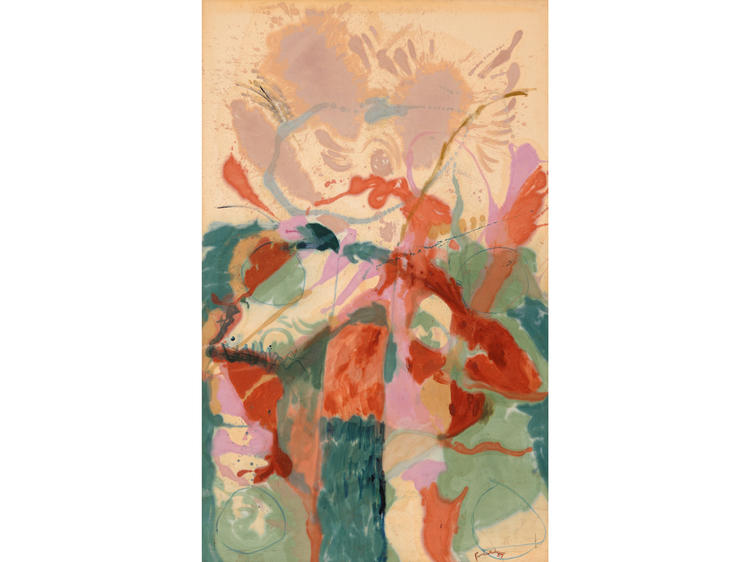
Jacob's Ladder (1957), Helen Frankenthaler
Rank: 95
In the vibrant New York art scene of the 1950s, Frankenthaler developed her own brand of Abstract Expressionism, working on unprimed canvas placed direct on the flooring and diluting her pigments with turpentine so they soaked straight into the canvas rather so rested upon it.—Heather Corcoran
Photograph: Courtesy the Museum of Modern Art, NY. Gift of Hyman Due north. Glickstein © 2015 Helen Frankenthaler / Artists Rights Society (ARS), New York
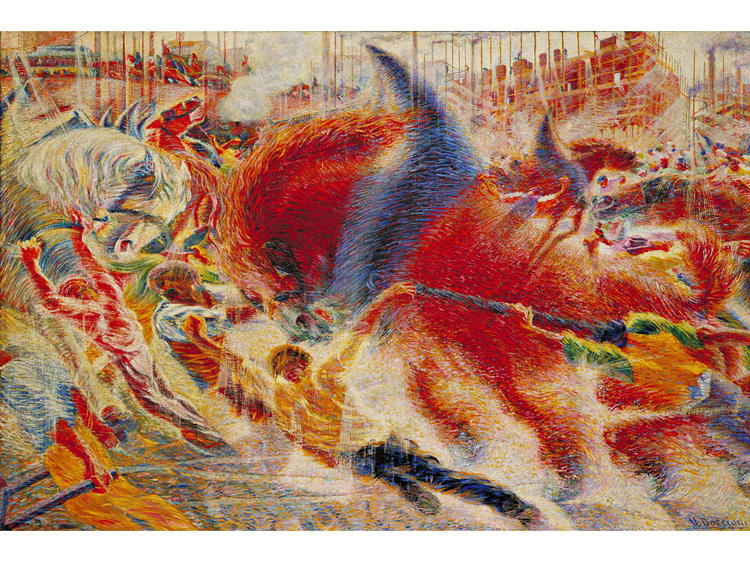
The City Rises (1910), Umberto Boccioni
Rank: 91
This is the offset major futurist piece of work by Boccioni. Depicting a power plant in construction, he has abandoned naturalism to express applied science through electrified paint treatment. Man and mythical oversized beast work together in flux and dynamic energy to build the city: the utopian ideal of futurists before World War I.—Jennifer Coates
Photo: Courtesy the Museum of Modern Fine art, NY. Mrs. Simon Guggenheim Fund
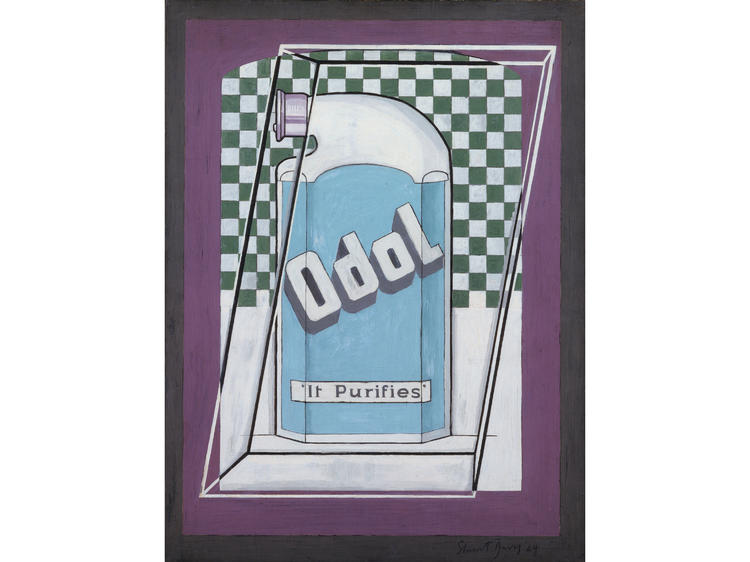
Odol (1924), Stuart Davis
Rank: 83
Throughout his career, Davis bridged the realism of Robert Henri and the Ashcan School to more than modernistic impulses including Postimpressionism and Cubism. Inspired by the American urban center, Davis's paintings of everyday objects, like this stylized canteen of mouthwash, presaged Popular Art by four decades.—Heather Corcoran
Photograph: Courtesy the Museum of Modern Art, NY. Mary Sisler Bequest (past substitution) and purchase

Gold Marilyn Monroe (1962), Andy Warhol
Rank: 61
No Warhol demonstrates the artist'due south worship of glamour improve than this painting, created the year Monroe died in an apparent suicide. It is the altarpiece in Andy's Pop Art church of celebrity. But by the aforementioned token, the work likewise speaks to Warhol's background as an observant Catholic; it wouldn't look all that out of place at St. Peter's Basilica in Rome or at St. Patrick'southward Cathedral on 5th Avenue, where Warhol regularly attended mass (sans wig). The prototype is based on a publicity still for the film Niagara, in which Monroe played opposite Joseph Cotton every bit an unhappily married woman, plotting the murder of her husband.—Howard Halle
The Museum of Modern Art, NY. Souvenir of Philip Johnson. © 2015 Andy Warhol Foundation for the Visual Arts / Artists Rights Society (ARS), New York
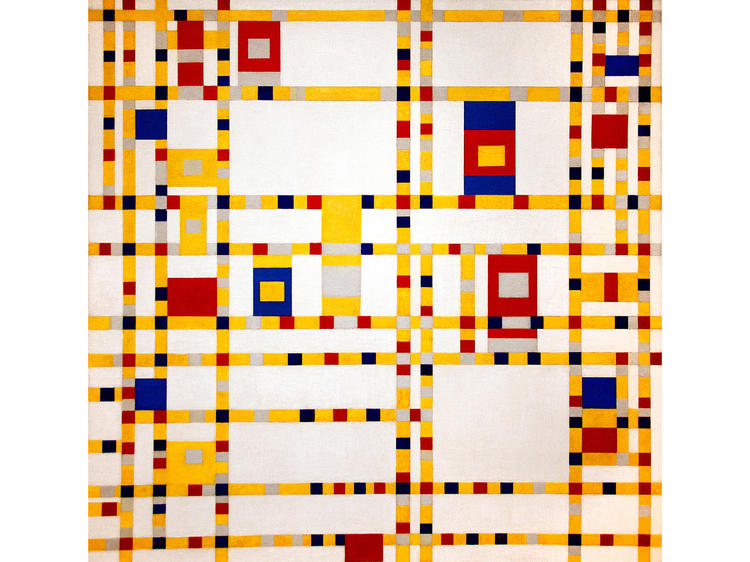
Broadway Boogie Woogie (1942–43), Piet Mondrian
Rank: 59
Mondrian came to New York in 1940, fleeing the Nazi invasion of his native Holland. He died hither iv years later, and though he probably didn't know it at the fourth dimension, his cursory sojourn would have a lasting, if delayed, impact on American art. Though AbEx put the U.S. on the map, Minimalism was to become our most indelible stylistic export, and its rigorous, reductive geometry owed a lot to Mondrian's De Stijl artful.Broadway Boogie Woogie, his second-to-concluding painting, is a honey letter of the alphabet to his adopted domicile, inspired past jazz and the energy of the Gotham's streets—a strangely prescient, if abstruse, portrait of the city every bit the centre of a nascent superpower.-—Howard Halle
Peter Horree / Alamy

Suprematist Composition: White on White (1918), Kazimir Malevich
Rank: 57
Though information technology was painted nearly a century ago, this painting's radical nature continues to astonish. Malevich's aim wasn't pure reductivism, though. Inspired by Russian federation'due south icon tradition, the early Soviet avant-gardist believed that the Russian Revolution had ushered in a new age in which materialism would give way to spirituality. He chosen his philosophy Suprematism, and White on Whiteserves every bit the supreme manifestation of the creative person reaching for transcendence.—Howard Halle
Photograph: Courtesy the Museum of Modern Art, NY. 1935 Conquering confirmed in 1999 by understanding with the Estate of Kazimir Malevich and fabricated possible with funds from the Mrs. John Hay Whitney Bequest (by exchange)
An email you'll actually love
🙌 Awesome, yous're subscribed!
Thanks for subscribing! Look out for your get-go newsletter in your inbox soon!
Source: https://www.timeout.com/newyork/art/the-100-best-paintings-in-new-york-museum-of-modern-art

Post a Comment for "The Museum of Modern Art New York Painting and Sculpture Acquisitions 1962"